
ROAS vs ROI 2026: The Ultimate Guide to Profitable Marketing Growth

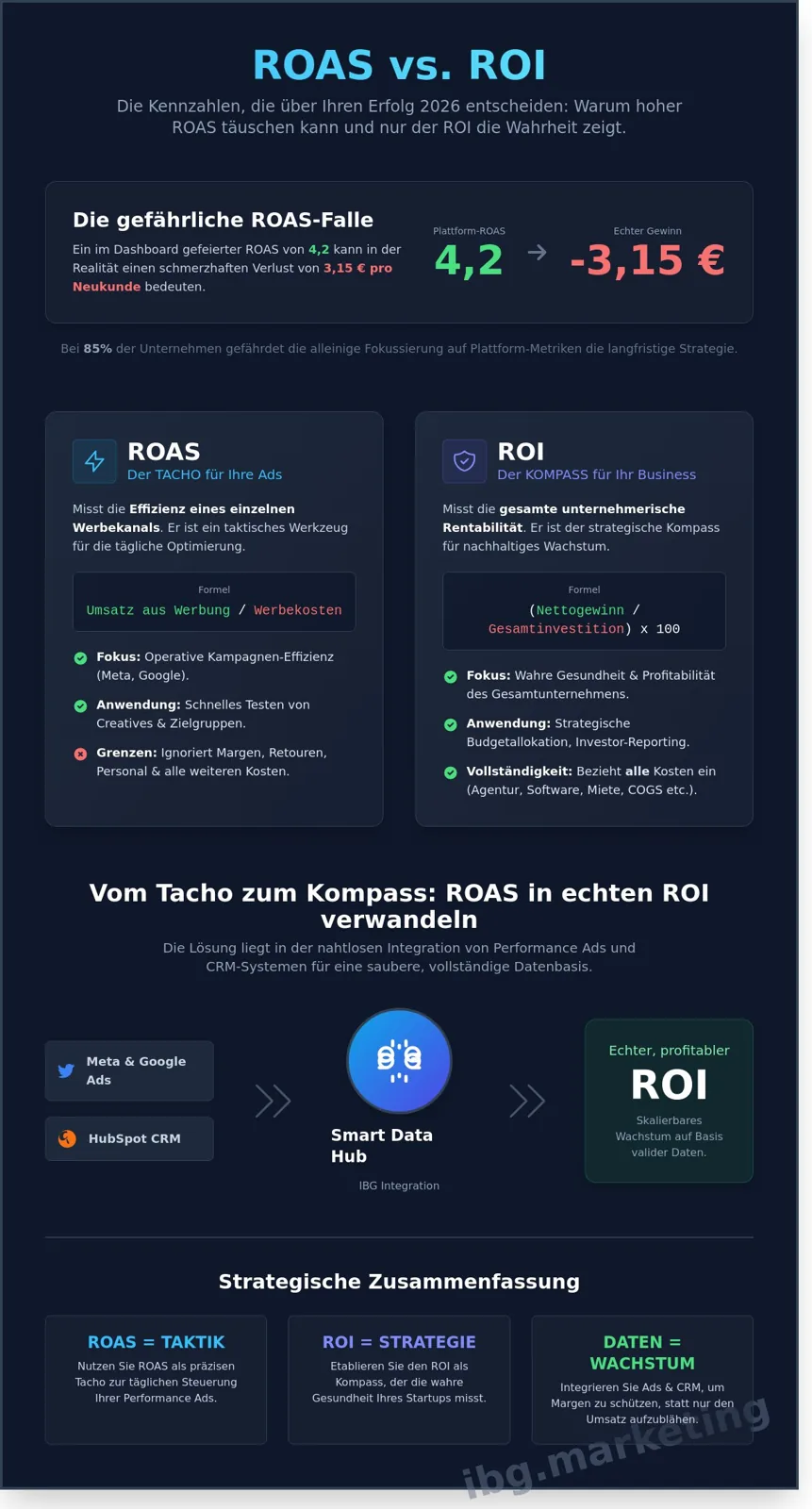
What if your supposedly strong Meta Ads ROAS of 4.2 actually means you lose €3.15 on every new customer? Many founders and marketing leads in Geltendorf rely blindly on the polished dashboards their agencies show them, while the real cash-flow picture tells a completely different story. The fatal mistake often lies in misunderstanding the metrics of ROAS vs ROI, which in 2026 inevitably leads to expensive budget waste. You probably know yourself how frustrating it is when click prices rise and the silos between marketing spend and your CRM data make clear success measurement impossible.
In this guide from IBG - Innovate Business Growth, we show you how to end this lack of transparency and steer your startup toward real, profitable growth. We promise you a crystal-clear strategy for budget allocation that goes far beyond surface-level metrics. You will learn how to protect your margins by seamlessly integrating performance ads with CRM systems like HubSpot or Klaviyo, instead of merely inflating revenue. We take a look at the future of conversational commerce via WhatsApp and explain why a clean data foundation is the only lever to hold your ground against the competition in 2026.
Key Takeaways
• Understand the fundamental difference between ROAS vs ROI, so you can clearly separate ad efficiency from true business profitability.
• Use ROAS as a precise speedometer for your performance ads on Meta and Google, to optimize bidding strategies with data in 2026.
• Establish ROI as the strategic compass that, by factoring in Customer Lifetime Value (CLV), measures the true health of your startup.
• Avoid the ROAS trap and learn why a high platform figure alone, without accounting for rising acquisition costs, does not guarantee profitable growth.
• Discover how integrating CRM systems like HubSpot and WhatsApp marketing turns your campaigns into a scalable overall system for the Munich market.
ROAS vs ROI: The Fundamental Differences in 2026
In 2026, Munich startups face a harsh reality. The days when venture capital flowed blindly into the growth of e-commerce brands are over. Today, profitability from day one is what counts. While ROAS (return on ad spend) serves as an agile gauge for the efficiency of individual advertising platforms, ROI represents the ultimate business truth. A high ROAS looks impressive in a report, but with a flawed calculation of fixed costs it can lead straight to insolvency.In the current market environment of Q1 2026, an isolated view of revenue is no longer enough. Across 85% of our new clients, we observe that focusing purely on platform metrics endangers the long-term strategy. ROAS steers the campaign in the here and now; ROI decides whether the company still exists in two years. It is the difference between short-term tactical moves on Meta and the sustainable scaling of a business model.
To understand these concepts better, this video helps:
What Is ROAS and How Is It Calculated?
ROAS is the classic metric for performance marketing. The calculation is simple: revenue from advertising divided by advertising cost. If you invest €2,000 in TikTok Ads and generate €10,000 in revenue from it, your ROAS is 5 (or 500%). This number is deceptive, because it completely ignores operating costs (COGS), shipping fees and staff expenses.
Focus
Operational efficiency of a specific advertising channel.
Limits
Does not account for return rates or overhead.
Use
Fast testing of creatives and audiences.
For the precise steering and daily optimization of Meta Ads, ROAS is the sharpest sword for separating winning campaigns from money burners.
What Is ROI and Why Does It Matter More for SMEs?
ROI looks deeper into your company's books. The formula is: (net profit / cost of investment) x 100. Here we deduct every cost that was necessary to generate the revenue. That includes agency fees for IBG Marketing, software subscriptions like HubSpot or Klaviyo, as well as the rent for your office in Munich.
A positive return on investment (ROI) is the only metric that truly counts for investors and stakeholders. While ROAS merely validates the advertising platform, ROI validates your entire business model. Anyone who leaves fixed and variable costs out of this calculation is steering blindly toward a cash-flow crisis. For SMEs with limited budgets in particular, ROI is the decisive factor for allocating resources across all of 2026.
ROAS: The Speedometer for Your Performance Ads on Meta and Google
For startups in Munich, return on ad spend (ROAS) is the most important metric for evaluating the immediate success of campaigns. It shows you precisely how many euros of revenue each euro invested in Google Ads or Meta Ads has generated. While the ROAS vs ROI debate is often held in the abstract, ROAS is what decides, in day-to-day operations, between scaling and cutting budget. At IBG, we consistently rely on tROAS bidding strategies (target ROAS) to give the algorithms clear guardrails. That enables maximum reach with stable efficiency.
But caution is required: a high ROAS does not automatically mean a high net profit. For strategic scaling, we have to look deeper into the data. In 2026, growing tracking blindness and complex attribution models make measurement considerably harder. Data gaps of up to 25% from cookie rejection are now the norm. Anyone who relies only on the dashboard numbers is flying their company blind through the digital market.
Optimizing Meta Ads Through Precise Tracking
To close these data gaps, we implement the Meta Conversions API (CAPI) for our clients. This interface sends event data directly from your server to Meta, which massively improves data quality compared to the browser pixel alone. A ROAS of 500% looks fantastic at first glance. But if your e-commerce return rate is 45%, hardly any margin is left at the end. That is why we connect ad data directly with HubSpot, to make the entire customer journey, including cancellations, visible.
Google Ads and the Fight for the Profitable Click
In the competitive Munich market, CPCs (cost per click) rise steadily. Here we strictly distinguish between brand ROAS and generic ROAS. While brand campaigns often achieve a ROAS of over 1,200%, the real art lies in the profitability of generic search terms. We use AI-powered bidding to react to user signals in real time and secure ROAS maximization. Anyone who neglects the ROAS vs ROI comparison here often overlooks that expensive generic clicks may lift revenue, but can drag down ROI through high acquisition costs.
Do you finally want to evaluate your performance data reliably and scale profitably? Let us analyze your current tracking infrastructure together.
ROI: The Compass for Your Business Growth
ROI is the decisive metric for the long-term survival of your startup. While ROAS merely measures revenue per advertising euro invested, ROI looks at the entire business picture, including salaries, software fees and agency costs. For founders in Munich that means: a high ROAS is a worthless vanity marker if operating fixed costs eat up the profit by the end of the quarter. In the strategic analysis of ROAS vs ROI, ROI always wins when it comes to real scalability and sustainable cash flow.
For agile companies with 5 to 15 employees in particular, integrating Customer Lifetime Value (CLV) decides success. Anyone who looks only at the first purchase massively underestimates the profitability of their campaigns. We calculate for you how much a customer is worth over a period of 12 to 24 months. Through process automation with Zapier, we often cut our clients' manual workload by more than 25 percent. That lifts ROI immediately, because expensive working time is freed up for strategic tasks. Our work with Brera Serviced Apartments impressively shows how increased CRM efficiency lowers the cost per booking and raises overall returns.
CRM Systems as ROI Enablers
Data silos between marketing and sales destroy capital. Through clean data consolidation in systems like HubSpot or Pipedrive, we create full transparency across the entire customer journey. You get automated reports that let you calculate the marketing ROI for your company precisely. This eliminates payments to inefficient channels and focuses your budget on the most profitable segments.
WhatsApp Marketing: An ROI Turbo Through Conversational Commerce
Compared to classic newsletters, WhatsApp campaigns often achieve click rates around 150 percent higher. This channel is a real ROI turbo, because it minimizes the barrier between prospect and close. Through automated funnels inside WhatsApp, we massively reduce staffing costs in sales. We rely on a GDPR-compliant tool landscape that enables legally sound scaling. Anyone who optimizes the entire sales path in the ROAS vs ROI comparison achieves margins that are unreachable with pure performance marketing alone.
Why a High ROAS Alone Will Not Save Your Munich Startup
Many founders in the Munich ecosystem let themselves be dazzled by a ROAS of 500%. In reality, though, a high return on ad spend does not automatically mean you are in the black at the end of the month. We often see the classic "ROAS trap": a startup scales its spend on Meta or Google while operating margins get eaten up by rising customer acquisition costs (CAC). In saturated markets, click prices rise by up to 15% a year, which minimizes the room for error.Anyone who focuses only on this vanity metric overlooks the business-critical calculation behind the click. That is why at IBG we rely on deep, data-driven analysis instead of superficial success curves in the ad manager. Only those who understand the dynamics of ROAS vs ROI can steer their budget efficiently and generate real growth.
The Hidden Costs in Performance Marketing
A profitable marketing mix consists of more than just raw media spend. To draw an honest balance, all fixed costs have to be taken into account:• Monthly agency retainers and consulting fees.
• Software costs for tools like Klaviyo, Pipedrive or Zapier.
• Spend on continuous content creation (UGC, graphics, copywriting).
Transparency is our highest value here. Our work with partners like Brera and Bridgewave is based on valid numbers that we openly document in our client logos and case studies. Seamless full-funnel tracking is the basic prerequisite for startups in Munich to trace every euro invested precisely, from first contact to final checkout.From Click to Customer: The Role of Conversion Rate
An excellent ROAS fizzles out to no effect if the landing page does not deliver the quality it promised. A poor user experience destroys ROI faster than a media budget can be scaled. When conversion rate stagnates, the "profit gap" widens with every additional euro of ad spend.We establish A/B testing and continuous optimization of the user journey as standard processes. By using modern dashboards, we visualize the difference between ROAS vs ROI in real time. That way we immediately identify where in the funnel capital is being lost. Whether through automated processes in GoHighLevel or targeted lead nurturing; operational excellence decides the long-term success of your startup.
Let us analyze your profit gap now and lift your ROI sustainably.
Strategic Scaling: How IBG Turns ROAS Into Real ROI
Many agencies celebrate a high ROAS as success in itself. At IBG Marketing we know: a ROAS of 5.0 on the Meta dashboard means little if return rates or fixed costs eat up the profit. The decisive factor in the ROAS vs ROI duel is the ability to translate ad spend into actual business growth. We do not view your campaigns in isolation, but as part of a holistic ecosystem.
Our approach combines precise performance ads with intelligent post-click optimization. Through the seamless integration of HubSpot and WhatsApp marketing, we create automated funnels that do not just win prospects but retain them. That raises Customer Lifetime Value (CLV) and makes sure your marketing budget works more efficiently than ever before.
Successful projects like the one with Bridgewave show what is possible when data guides strategy. There we did not just buy clicks, but massively boosted sales efficiency through CRM automation. We turn short-term advertising effects into long-term profitability by tuning every cog in your tool landscape to work in perfect concert.
Custom Growth Strategies for 2026
Off-the-shelf standard solutions will fail in 2026 against the complex demands of agile startups. Your business in Munich needs a strategy that combines local market knowledge with technical excellence. We do not develop cookie-cutter campaigns for you, but data-driven roadmaps tailored exactly to your growth goals and your funding stage.
Status-Quo Audit
We analyze your current ROAS vs ROI balance and uncover hidden cost drains.
Tech-Stack Optimization
We implement clean tracking solutions, so every decision is based on valid data.
Scaling Plan
In 90 days, we bring your ads and your CRM to a level that enables real, profitable growth.
Next Steps for Your Company
Is your current tool landscape of Klaviyo, Brevo and Meta really harmonized? Valuable potential is often lost because data does not flow between the platforms. We clean up your technical setup and create transparency in your KPIs. That way you keep full control over your margins and your scaling.
The road to more profit begins with a clear plan. In a free strategy call, we analyze your current performance data and show you the untapped potential of your funnel. Let us find, together, the levers that move your company forward sustainably in 2026.
Let us scale your ROI together in 2026. Book a free strategy call now.
Meta Description: ROAS or ROI? Learn why ROI is decisive for your startup. Book a strategy call now with the experts from Munich and scale profitably!
From Ad Spend to Real Business Profit: Your Roadmap for 2026
The direct comparison of ROAS vs ROI makes one thing clear: anyone who merely optimizes advertising platforms in 2026 leaves massive potential on the table. While ROAS measures the efficiency of your campaigns on channels like Meta or Google, ROI remains the decisive metric for the long-term growth of your startup. At IBG Marketing in Munich and Geltendorf, we therefore rely on a holistic system. We turn short-term clicks into real profitability through intelligent WhatsApp marketing funnels and a clean HubSpot integration.
Our work with partners like Brera and Bridgewave shows that data is worthless without the right strategy. We combine performance ads with smart automation to cut your acquisition costs by up to 30% and significantly raise Customer Lifetime Value. Do not wait for the algorithm to solve your problems; take your growth into your own hands. We help you achieve results that go far beyond mere advertising revenue.
Let us set the course for your profitable 2026 together. Book a free strategy call now.
Frequently Asked Questions About ROAS vs. ROI
What is a good ROAS in 2026?
In 2026, a profitable ROAS for most e-commerce companies in Germany is at least 400 percent, or a 4:1 ratio. In fiercely competitive sectors like fashion, values of 6:1 are often needed to absorb rising logistics costs and return rates. At IBG Marketing, we usually set the target for our Munich clients at an individual break-even ROAS tailored exactly to the product margin.
Can you have a high ROAS and still lose money?
Yes, this is a common scenario when the gross margin is too low or hidden costs like shipping, staff and returns are ignored. If your ROAS is 5:1, meaning your marketing costs make up 20 percent of revenue, but your margin is only 15 percent, you lose money on every sale. This is the heart of the ROAS vs ROI debate: ROAS measures only ad efficiency, while ROI reflects the real profitability of your business.
How does HubSpot help calculate ROI?
HubSpot acts as a central database that connects marketing spend directly with closed deals in the CRM. Through a clean HubSpot connection, we track the entire customer journey path from the first click to the final invoice. This transparency enables closed-loop reporting, so you can calculate ROI based on real payments received instead of mere click data.
Why is ROI more important than ROAS for investors?
Investors in the Munich startup scene look at long-term scalability and net profitability, which only ROI captures precisely. A high ROAS can be artificially inflated by expensive discount campaigns, which tends to harm company value over the long term. ROI, by contrast, accounts for all operating costs and shows in black and white whether the business model sustainably generates cash flow or merely burns capital.
What role does Zapier play in ROI optimization?
Zapier lifts ROI primarily by automating manual processes, which can cut operating costs in marketing teams by up to 35 percent. By connecting lead sources with CRM systems via Zapier, response times are shortened and the conversion rate is raised significantly. Less manual effort with higher output at the same time immediately improves the ratio of capital deployed to profit.
How do you calculate the ROI for WhatsApp marketing campaigns?
To calculate it, subtract the total campaign costs, made up of software fees, agency work and cost per message, from the contribution margin achieved, then divide the result by the total costs. In 2026, WhatsApp marketing often achieves conversion rates of over 40 percent in conversational commerce. Since engagement rates are well above email benchmarks, ROI here often reaches three times that of classic channels.
Which metric matters more for startups in the seed phase?
In the seed phase, ROAS is often the more important metric for quickly validating product-market fit and the scalability of advertising channels. Startups with 5 to 15 employees first have to prove they can acquire new customers efficiently before the focus shifts to full ROI optimization. Still, the ROAS vs ROI comparison must never be lost from sight, in order to keep the burn rate under control until the next funding round.
Turn this into results.
Branding, lead generation and done-for-you funnels, engineered with AI, live in weeks.
Book a free callChat on WhatsAppKeep reading

How to Set Up Automated Lead Rotation in HubSpot 2026: The Ultimate Guide
Set up automated lead rotation in HubSpot for 2026: cut response times, distribute leads fairly, and scale your sales team without
Read · 13 min →
Generating B2B Leads With Google Ads 2026: Strategies for Scaled Growth
Learn how to generate B2B leads with Google Ads in 2026: precise targeting, CRM automation with HubSpot and Zapier, and WhatsApp f
Read · 16 min →
CRM Implementation Checklist 2026: The Ultimate Guide for Agile Startups
Skip the costly CRM mistakes. This 2026 implementation checklist walks agile startups through strategy, data migration, and change
Read · 15 min →