
CRM Implementation Checklist 2026: The Ultimate Guide for Agile Startups

Excel lists are the graveyard of scalable growth. A brutal statement, but for ambitious startups it is the unvarnished truth. You feel it every day: outdated contact data in countless spreadsheets, manual follow-ups that get lost in day-to-day business, and a sales team flying blind. The thought of a CRM system is there, but so is the fear of exploding costs, data chaos and a team that boycotts the new software.
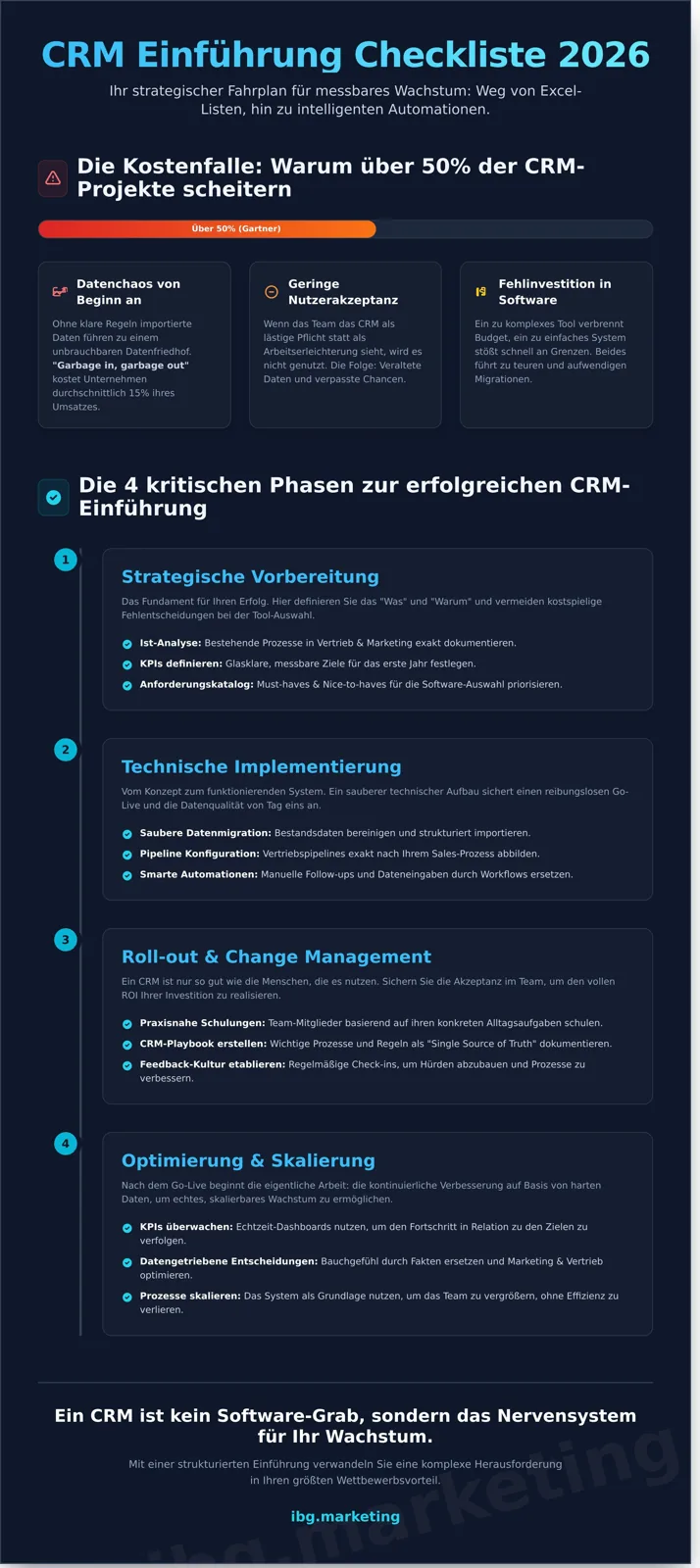
This is exactly where our field-tested CRM implementation checklist for 2026 comes in. It is your strategic roadmap so you do not end up among the more than 50% of companies whose CRM projects fail, according to Gartner. We hand you the exact process to set up a powerhouse like HubSpot cleanly from day one and replace your manual processes with smart automations.
In this guide, we take you from strategic goal-setting through tool selection to a successful implementation. The goal: not an expensive software grave, but a central nervous system for measurable revenue growth and the cornerstone of your scalable growth.
Key Takeaways
• A detailed requirements analysis is the first step to avoid costly wrong decisions when choosing a CRM and to set clear KPIs for your growth.
• Learn how to migrate existing data cleanly and configure your sales pipelines correctly from the start to ensure a smooth go-live.
• Successful change management is decisive: ensure high user adoption across the entire team with hands-on training and an internal CRM playbook.
• Our CRM implementation checklist for 2026 guides you in a structured way through all four critical phases and thereby secures the long-term success of your project.
Why a CRM Implementation Checklist for 2026 Is Indispensable
Forget Excel spreadsheets. In 2026, they are the graveyard of ambitious growth plans. For startups that do not just want to survive but dominate the market, a central system for customer relationship management (CRM) is not a tool, but the engine of the company. It is the digital nervous system that connects marketing, sales and customer service and makes scalable growth possible in the first place.
But implementing a CRM system does not happen on its own. Without a strategic roadmap, the project is like a flight without instruments: expensive, risky and highly likely to fail. A well-thought-out CRM implementation checklist is therefore not an optional luxury, but the strategic foundation to avoid bad investments and deliver measurable results from day one. It creates transparency for the entire team, for stakeholders and for investors who want to see how their capital flows into structured, scalable processes.
This structured approach is not only an internal advantage but also a basic requirement for successful fundraising. Platforms that connect startups with capital providers, such as Pre-IPO Hype, deliberately look for companies that can demonstrate this kind of operational maturity.
The days when a CRM was just a better address book are definitively over. Modern systems like HubSpot or Pipedrive are automation hubs today. They pre-qualify leads, personalize customer outreach and deliver the data basis for every strategic decision.
The Biggest Risks of an Unstructured Implementation
Without a clear plan, three cost traps lurk that have already made many a startup stumble. We see it again and again in our daily work in Munich: good intentions alone are not enough.
Data Chaos from the Start
"Garbage in, garbage out." If data is imported without clear rules and processes, an unusable data graveyard is created. A Gartner study shows that poor data quality costs companies an average of 15% of their revenue.
Low User Adoption
If the sales team perceives the CRM as a tiresome obligation rather than a relief, it will not be used. The result: outdated data, missed opportunities and an investment that never pays off.
Bad Investment in the Wrong Software
A tool that is too complex burns budget and resources needlessly. A system that is too simple hits its limits after six months and forces a costly, laborious migration.
CRM as the Basis for Data-Driven Decisions
A professional CRM implementation turns gut feeling into hard facts and lays the foundation for exponential growth. It is the prerequisite for modern, results-oriented company management.
Instead of manual Excel reports that are already outdated when they are created, real-time dashboards give you a 360-degree view of your pipeline. You see at a glance which marketing channels generate the most valuable leads and where your sales team needs support. This clean process architecture is the basis for real scalability. Only then can you automate processes and grow your team without losing efficiency.
For professional performance marketing, a clean CRM is an absolute prerequisite. Without a central, segmented data source, the targeted scaling of campaigns on Meta or Google is impossible. For our clients like Brera, the CRM database is the key to sustainably increasing the Return on Ad Spend (ROAS) and using marketing budgets with maximum efficiency.
Strategic Preparation: The Requirements List
Every successful CRM implementation begins long before the first demo. It begins with a fundamental question: where are we and where do we want to go? Without this strategic basis, even the best software is just an expensive, unused database. This step of your CRM implementation checklist is the most critical, because it defines the foundation for future growth.
The first step is an honest as-is analysis. Document exactly how your sales and marketing team currently works. Where are leads captured? How is the handover done? Which tools are in use? With our client Bridgewave in Munich, we uncovered that 25% of inquiries went unprocessed in the handover from marketing to sales, an enormous, untapped potential that we were able to fix through a centralized process in the CRM.
Based on this analysis, you define crystal-clear goals (KPIs) for the first year. Vague wishes like "more revenue" are not enough. You need measurable targets:
• Reduce the average lead response time from 24 to 4 hours.
• Increase the conversion rate from MQL to SQL by 15%.
• Raise customer satisfaction (NPS) by 10 points through personalized communication.
A well-founded development of a CRM strategy, as recommended by industry experts, makes clear that such KPIs make the difference between an investment and pure cost. Then set your budget. Plan not only the license costs, but also the implementation, employee training and any data migration. For an agile team of 10 employees, you should reckon with an initial investment between 4,000 and 20,000 euros. Also appoint an internal project owner and key users who drive the project forward and serve as points of contact.
Requirements for Modern CRM Software
A modern CRM has to do more than just manage contacts. For dynamic startups, three points are non-negotiable: cloud-based access for maximum flexibility, strict GDPR compliance with an EU server location, and an open API. Only then can indispensable tools like Zapier or your accounting tool be integrated seamlessly to eliminate manual work.
Focus on Conversational Commerce: WhatsApp Integration
Look ahead to the future right now. By 2026, direct customer outreach via messenger will become the standard. That is why a native WhatsApp marketing integration belongs on every requirements list. Picture this: automated follow-up sequences and personalized offers that are visible directly in the customer's chat history in the CRM. That is the future of sales, provided the implementation is 100% legally sound and compliant.
Technical Implementation: Step by Step to Go-Live
The strategy is set, the goals are defined. Now begins the decisive phase in which a plan becomes a powerful tool. The technical implementation is the foundation of your future sales success. This is where the course is set for efficiency, scalability and clean data. Mistakes in this phase later cost not only time, but above all hard cash.
For the basic IT infrastructure, data security during migration and ongoing technical support, working with an experienced IT service provider is often decisive. Such a partner, for example reisinformatica.com, ensures that the technical framework for the new software is optimal.
The first and most important step is data migration. Here the unshakable principle applies: "garbage in, garbage out". Feeding a new CRM system with dirty, outdated or duplicate data is like putting the wrong fuel in a sports car. It will not work. Whether you are moving from Excel lists or a legacy system, a radical data cleanup is mandatory. For our clients in Munich, such as the tech startup Bridgewave, we increased data quality by over 40% through consistent cleanup before a single record was migrated.
In parallel, we configure your sales pipeline. Your CRM has to reflect your real sales process, not the other way around. The deal stages must mirror exactly how your team works. A typical B2B process might look like this:
Lead Generated
A new contact from a Meta ad or the website form.
First Contact Made
Sales has contacted the lead.
Needs Analysis
The requirements and the potential of the lead have been qualified.
Proposal Sent
A concrete offer is in front of the potential customer.
Negotiation
Details and terms are being discussed.
Won / Lost
The outcome is documented.
Another critical point on every good CRM implementation checklist is setting up user roles and permissions. Not every employee needs access to all data. A sales manager needs different dashboards than a junior sales rep. Clear permissions not only protect sensitive data but also create focus and prevent accidental mistakes. Finally, all relevant marketing channels are integrated seamlessly so that every lead lands directly in the CRM without any manual detours.
Process Automation with a System
This is where the magic begins. Automation is the lever to achieve great things with a small team. We set up lead-scoring models that automatically rate your leads by potential. This way your sales team focuses only on the hottest contacts. Workflows for email follow-ups ensure that no lead is forgotten. By intelligently connecting third-party systems via platforms like HubSpot, we create an ecosystem in which data flows smoothly and manual tasks are eliminated.
Securing Data Quality Permanently
The implementation is only the beginning. Without clear rules, even the best database quickly deteriorates into unstructured chaos. We define strategic required fields to ensure that critical information is captured with every data entry. An automated duplicate check prevents duplicate contacts and companies from the start. In addition, we plan regular, quarterly audits with you to check data integrity and keep your CRM as a reliable "single source of truth".
Roll-out and Change Management: Bringing the Team on Board
The best software is useless if no one operates it. A CRM system only unfolds its full potential through high user adoption. That is exactly why change management is the decisive factor that often determines the success or failure of the entire implementation. It is about turning skeptical employees into real fans who recognize and use the value of the new system every day.
Forget hours-long lecture-style training. Rely on short, hands-on workshops geared to the real workflows of your teams. A 45-minute deep dive on "efficient deal capture for sales" brings more than a half-day of theory. Document all processes, rules and best practices in a central, digital CRM playbook, for example in Notion. That is the only "source of truth" for your team.
Establish an open feedback culture from day one. A dedicated Slack channel (#crm-feedback) or short, biweekly check-ins are ideal for quickly identifying hurdles and adjusting processes. This way the team feels heard and becomes part of the solution. And do not underestimate the power of incentives. Gamification works wonders: reward the person with the best data-maintenance discipline at the end of the month with a voucher or an extra afternoon off. This boosts motivation and data quality enormously.
From Tool Frustration to Workflow Enthusiasm
Resistance to new tools is normal. Break it down by creating immediately visible quick wins. Show sales how a simple automation makes the manual entry of contact data after a phone call unnecessary. That is 10 minutes of time saved per conversation. Train the mobile app specifically, because for field sales it is a game changer to capture notes and deals right after a customer appointment in the car instead of in the office in the evening.
In addition, identify 1-2 tech-savvy "CRM champions" in your team. Give them advanced knowledge and position them as the first point of contact for colleagues. This relieves the project management and promotes knowledge transfer on equal footing.
Continuous Optimization After Go-Live
With the go-live, your CRM implementation checklist does not end, it really begins. The work on processes is never finished. Analyze the usage statistics monthly: how often do users log in? How many new activities are created per user? If adoption is below 80% after 6 weeks, you need to act.
Adapt your sales pipeline to reality. Maybe it turns out that a stage in the sales cycle is superfluous or a new one is needed. An agile CRM thrives on such adjustments. Expand the feature scope step by step with new automations. With tools like Zapier, countless apps can be connected and processes created that save your team dozens of hours per month. Do you want not just to implement your CRM system, but to turn it into a real growth engine? We support you with the technical implementation and the ongoing management so that your team can focus fully on sales.
CRM Success with IBG: Why Startups Rely on Us
A successful CRM implementation is no accident. It is the result of a clear strategy, technical excellence and a partner who understands your business model. Especially for agile startups, the choice of the right implementation partner is the decisive lever to not just plan growth but implement it systematically. This is exactly where we come in.
We at IBG - Innovate Business Growth specialize in HubSpot CRM implementation for small and medium-sized businesses. Our expertise goes far beyond the pure technology. We create data-driven ecosystems in which marketing, sales and service mesh seamlessly. Our projects with clients like Brera and Bridgewave prove that our approach works: for Bridgewave, we were able to increase the conversion rate from qualified lead to customer by 22% in just six months through automated lead nurturing.
With our base in the tech hub of Munich, we are close to the pulse of the DACH region and understand the challenges of fast-growing companies. We view your company holistically. For us, a CRM is not an isolated piece of software, but the heart of your growth strategy, which we bring to life from performance ads to automated customer communication.
Our Path to the Perfect CRM Landscape
Our process is transparent, proven and designed to deliver measurable results quickly. We go far beyond a generic CRM implementation checklist and develop a tailored solution for your specific goals.
Strategy Workshop for Process Definition
In an intensive workshop, we analyze your existing workflows. Together we define what your ideal sales and marketing processes look like and which data points are decisive for your growth. The result is a concrete blueprint for your CRM architecture.
Technical Implementation and Migration
Our certified experts take care of the complete technical setup, configuration and the secure migration of your existing data. We ensure a smooth transition without interrupting your day-to-day operations.
• Ongoing support in the management retainer: The launch is only the beginning. As part of our ongoing support, we continuously optimize your system, train your team and make sure your CRM scales as a strategic tool alongside your company.
Scale Your Growth Now
Do you feel that outdated processes or missing data are blocking your growth? Do not wait any longer. The right time to professionalize your customer relationships is now. Let's lay the foundation for your success in the coming years together.
Request an Individual Consultation
Book a no-obligation strategy call and learn how we can support your startup.
Review Our References
Convince yourself of the quality of our work through the projects of our satisfied clients.
Start Your Project in 2026
Get in touch with us directly to plan your CRM project ahead of time and secure our capacity.
Ready for 2026: Turn Your CRM into a Growth Engine
You have seen it: a successful CRM implementation is not a sprint, but a strategic marathon. The key lies not only in choosing the right software, but above all in careful planning, technical precision and change management that truly brings your team along. A detailed CRM implementation checklist is your most important tool to avoid pitfalls and achieve measurable results from day one.
As a certified HubSpot partner and expert in WhatsApp marketing & automation, we know what matters. We have helped agile startups like Brera and Bridgewave scale their processes and revolutionize customer relationships. We do not just implement a tool; we build the foundation for your future growth.
Avoid costly mistakes and rely on a proven strategy from the start. Book a free strategy call for your CRM implementation 2026 now.
The right time to leave your competition behind is now.
Frequently Asked Questions About CRM Implementation (FAQ)
How long does a CRM implementation take on average?
A CRM implementation for an agile startup with up to 15 employees takes on average between 4 and 8 weeks. This time frame covers all the decisive phases: from the initial strategy and requirements analysis through technical configuration and data migration to the final employee training. For complex projects with deep integrations into existing systems, the duration can extend up to 12 weeks.
Which CRM software is best for startups with 10 employees?
For startups with around 10 employees, we recommend scalable and integration-friendly CRM systems like HubSpot or Pipedrive. HubSpot impresses with its all-in-one concept, which connects marketing, sales and service seamlessly. Pipedrive shines with its intuitive interface focused on the sales process. Both systems offer fair entry packages that scale effortlessly with your company's growth and fit perfectly into a modern tool landscape.
Is a CRM implementation also possible without an external agency?
Yes, a CRM implementation is theoretically doable without an external agency, but practice shows high risks. Over 50% of internally run CRM projects fail or do not reach their set goals, because the effort for process definition, data migration and change management is massively underestimated. A specialized agency like IBG Marketing in Munich secures success through proven strategies, prevents costly mistakes and maximizes the return on investment from day one.
How high are the costs for a professional CRM implementation in 2026?
The costs for a professional CRM implementation by an agency typically range between 4,500 and 9,000 euros for a startup in 2026. This price range includes strategic consulting, the complete technical setup, the migration of existing data as well as the first user training. Not included are the ongoing license costs of the software, which start at around 20 to 50 euros per user per month depending on the provider and package.
What is the most important point on a CRM checklist?
The absolute most important point on any CRM implementation checklist is the precise definition of your business goals and the associated KPIs. Without measurable goals, your CRM becomes a pure data grave. Define in advance what you concretely want to improve: shortening the sales cycle by 25%? Increasing the lead conversion rate by 15%? Only these goals determine the necessary configuration and the later success reports.
Turn this into results.
Branding, lead generation and done-for-you funnels, engineered with AI, live in weeks.
Book a free callChat on WhatsAppKeep reading

How to Set Up Automated Lead Rotation in HubSpot 2026: The Ultimate Guide
Set up automated lead rotation in HubSpot for 2026: cut response times, distribute leads fairly, and scale your sales team without
Read · 13 min →
Generating B2B Leads With Google Ads 2026: Strategies for Scaled Growth
Learn how to generate B2B leads with Google Ads in 2026: precise targeting, CRM automation with HubSpot and Zapier, and WhatsApp f
Read · 16 min →
B2B CRM Strategy 2026: The Ultimate Guide to Scalable Sales Processes
Build a data-driven B2B CRM strategy for 2026: automate your sales pipeline, align marketing and sales, and scale conversions with
Read · 17 min →