
Google Ads vs. SEO 2026: The Ultimate Strategy for Scaling Startups

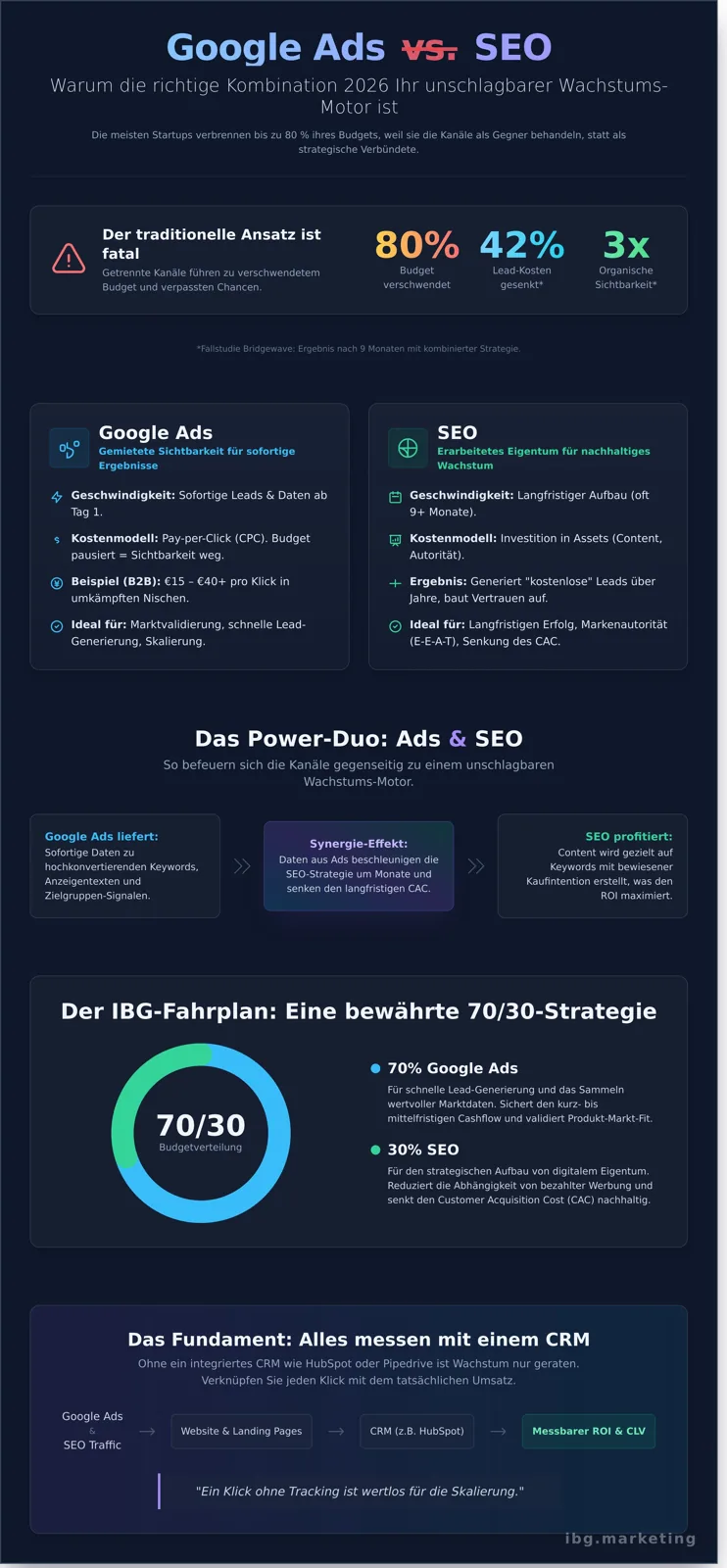
Most startups burn up to 80% of their marketing budget because they ask the "Google Ads vs. SEO" question the wrong way. They treat the channels as bitter enemies fighting over budget, instead of using them as strategic allies that fuel each other.
You know the feeling all too well: click prices in Google Ads have risen relentlessly since Q4 2023 and are threatening your unit economics. At the same time, SEO wins feel agonisingly slow, often too slow for the next decisive funding round. It is a constant balancing act between short-term wins and sustainable growth, one where transparency about the true customer lifetime value (CLV) often falls by the wayside.
We show you how to end this fight. In this article, you get the exact roadmap for how to combine Google Ads and SEO into an unbeatable power duo in 2026. A data-driven machine that not only generates qualified leads but funnels them straight into your CRM like HubSpot or Pipedrive, maximising your ROI.
Discover the strategy with which we cut lead costs by 42% for Munich tech companies like Bridgewave while tripling their organic visibility in just nine months.
Key Takeaways
• Learn why the strict separation of paid and organic search is fatal in 2026 and how to combine both channels into an unbeatable growth engine.
• Discover how the data from your Google Ads campaigns accelerates your SEO strategy by months and lowers customer acquisition cost (CAC) in the long term.
• We show a proven 70/30 budget split for the Google Ads vs. SEO debate that secures fast leads through ads and sustainable organic growth.
• Understand how an integrated CRM like HubSpot makes the performance of both channels measurable, and why a click without tracking is worthless for scaling.
Google Ads vs. SEO: The New Reality of Search in 2026
The "Google Ads vs. SEO" debate is a relic from a simpler time. In 2026, shaped by Google's Search Generative Experience (SGE), this question is not only outdated, it is dangerous. Anyone still thinking in separate channels today is handing the field to their competitors. AI-powered search delivers direct answers and has fundamentally changed the rules of B2B lead generation.
To understand the new dynamic, watch this video that covers the basics of both disciplines:
For ambitious startups, the strict separation of paid and organic search is the direct route to invisibility. Why? Because Google wants to keep users on the results page for as long as possible. So-called "zero-click searches," where users find their answer directly in search, have risen from under 40% in 2019 to over 50%. Organic traffic has to be reassessed: it is no longer just about the click, but about the presence and authority of your brand right inside the AI-generated answers. This is exactly the hybrid approach we pursue successfully with Munich tech startups like Brera and Bridgewave, to achieve maximum market penetration.
What Is Google Ads 2026? Performance at the Push of a Button
Today, Google Ads is a synonym for AI-driven efficiency. Campaigns like Performance Max analyse millions of data signals in real time to serve your ads to exactly the B2B decision-makers who are on the verge of a purchase decision. The advantage is unbeatable: instant visibility for high-converting, transactional keywords. You do not have to wait for months. You get data immediately. Think of Google Ads as your rented visibility for fast market feedback and immediate lead generation.
What Is SEO 2026? Authority in the Age of AI
Technical SEO is now just the entry ticket. The real currency in the battle for top organic positions is content authority, summarised in Google's E-E-A-T principle (Experience, Expertise, Authoritativeness, Trustworthiness). While traditional search engine optimization (SEO) focused heavily on technical aspects, AI today rewards deep, human-centred expert knowledge. It is about building trust with informative content and standing out as the logical solution for transactional search queries. SEO is not a short-term sprint, it is the building of a valuable digital asset, your property, that generates leads sustainably and with compounding returns.
The Direct Comparison: Cost, Time, and Scalability
The decision between Google Ads and SEO is not a matter of taste, it is a strategic choice. It is based on hard facts: the cost per lead, the time needed until the first success, and the ability to scale the measures profitably. Let's look at the dimensions that really matter for B2B decision-makers.
The most obvious difference lies in the cost model. With Google Ads, you pay per click (cost-per-click, CPC). In fiercely contested German B2B niches like "ERP software for SMBs," click prices from 15 € to over 40 € can be the norm. So 100 qualified clicks quickly cost you between 1,500 € and 4,000 €. The costs are direct, transactional, and stop the moment you pause the budget. You are renting visibility.
SEO, on the other hand, is an investment in an asset you own. Instead of paying per click, you invest in creating high-quality content, technical optimisations, and building authority. A strategic pillar-content article can cost 2,000 € to produce, but once it ranks successfully, it generates leads for years without further variable costs. You are building a lead machine that belongs to you.
These fundamental differences shape the Google Ads vs. SEO debate and define which channel suits which business goal.
Time to First Lead
With Google Ads, you can generate the first enquiries within 24 hours. SEO usually needs 6 to 12 months to become a stable and measurable lead source.
Scalability
Google Ads scale linearly. Double the leads often means nearly double the budget, and the cost-per-acquisition (CPA) can even rise with increasing volume. SEO scales exponentially: once established, the effective cost per lead falls continuously, because traffic grows without a proportional increase in cost.
Risk Management
Ads are 100% dependent on the advertising budget. No budget, no leads. SEO is dependent on the Google algorithm. However, a solid, diversified content strategy minimises this risk considerably.
ROI Analysis: When Each Channel Pays Off
The break-even point for SEO is a simple calculation: invest 3,500 € a month in content and optimisation, and your average B2B lead is worth 200 €, you reach break-even at 18 leads per month. Once that goal is reached after 10 months, your content asset works profitably for you from that point on. Google Ads, on the other hand, is the perfect instrument for validating hypotheses quickly, ideal for launching a new SaaS feature or testing a new market, without a long-term commitment.
Staffing Effort and Technical Setup
Both channels require deep expertise. For Google Ads, you need a performance marketing manager who knows automated bidding strategies and data analysis. For SEO, content strategists, technical SEO specialists, and outreach managers are in demand. Professionals use tools like Ahrefs for SEO analysis or the smart-bidding options in Google Ads. For companies that cannot or do not want to build this expertise in-house, outsourcing to specialists is the most efficient route. You can find an overview of professional channel management under our IBG services.
The Biggest Misconception: "We'll Do SEO Once We're Big"
This sentence is one of the most expensive a B2B startup can say. It is the idea that SEO is a luxury for established companies, while at the start you have to buy "fast" leads through Google Ads. That is not only wrong, it is a strategy that is guaranteed to drive up your customer acquisition cost (CAC) and slow your growth in the medium to long term.
Anyone relying exclusively on paid ads is only renting their traffic. The moment you cut the budget, the stream of leads dries up. Immediately. SEO, on the other hand, builds its own sustainable channel, an asset that generates qualified enquiries for years without paying per click. Waiting on SEO makes you dependent on Google's constantly rising click prices. For SaaS companies in Munich or Hamburg, the CPCs for transactional keywords quickly reach 8 € to over 20 €.
The real problem, though, is "brand erosion." B2B decision-makers are experienced. If your brand appears exclusively in paid ads but is organically invisible, the foundation of authority and trust is missing. Top organic rankings are a seal of quality that you cannot simply buy. They signal market leadership.
The most common objection we hear: "SEO takes too long, we need results for the next funding round in 9 months." This is a misunderstanding of SEO's strategic role. It is not about generating 500 organic leads in 9 months. It is about presenting investors with a scalable growth model that is independent of pure ad spend. The foundation you lay today is the proof of tomorrow's profitability.
Using Keyword Synergies: Learning From Ads for SEO
The smart solution in the Google Ads vs. SEO duel is not an "either-or" but a "with each other." Google Ads delivers data in weeks that SEO would need months for. Here is how you use this unfair advantage for your content pipeline:
Validate Winning Keywords
Invest a test budget of 1,500 € in Google Ads to test 10-15 promising keywords. After 30 days, you know exactly which 2-3 terms bring not just clicks but also demo requests or consultation calls.
Decode Search Intent
Is "CRM automation" a search query for a software comparison or a "how-to" guide? The click and conversion data from your ads give the answer and steer your content production in the right direction.
Feed the Content Pipeline
The keywords with the highest conversion rate from your ads campaigns become the top priority for your SEO strategy. You no longer produce content on a hunch, but on the basis of hard market data. This method accelerates SEO success by at least 3-4 months.
This principle of data-driven content creation is universal, whether in the B2B SaaS space or in e-commerce. Even a specialised online shop for sweets has to align its content with users' search intent to be successful. You can find an interesting international example of such a content strategy in the B2C space at jublacandy.com.
A good example from the German market is the food niche: a retailer who wants to be found as an Indian grocery online Germany has to align its SEO and ads strategy precisely with the needs and search queries of customers looking for authentic products.
Retargeting: The Bridge Between SEO Traffic and Sales
SEO brings you highly interested visitors who are actively searching for solutions. The cold truth, however, is: over 95% of these visitors will not convert on their first visit. Without a bridge, these valuable contacts are lost. That bridge is retargeting.
By re-engaging visitors to your blog articles (SEO traffic) via Meta Ads or Google Ads, you combine the best of both worlds: the trust built through organic content and the targeted, paid reminder. Show these users an ad with a concrete offer, like a whitepaper or a free strategy call. This is how you systematically turn organic reach into measurable B2B leads and maximise the ROI of both channels.
Data-Driven Growth: The Role of CRM and Automation
A click is only a click. A lead is only a contact. Only when you know where a qualified prospect comes from and what they do after first contact do you turn marketing spend into measurable revenue. The Google Ads vs. SEO debate becomes irrelevant if you do not track the customer journey seamlessly. A click without tracking in the CRM is burned money.
This is exactly where modern B2B marketing begins. It is not about playing channels off against each other, but about orchestrating them in an intelligent system. The heart of this system is a CRM like HubSpot, which brings together all data points from the first Google search to the final signed contract. This is how we create a 360-degree view of every single lead and can automate the entire process.
The decisive lever? Speed and relevance. A lead who becomes aware of you through an ad or an SEO article has to be addressed immediately and personally. Automated nurturing funnels that start right after the first contact are the standard. The game-changer, however, is direct qualification through channels like WhatsApp, which beat the classic email funnel by a mile.
Attribution 2026: Which Channel Really Generated the Lead?
The B2B customer journey is complex. A decision-maker might see your Google Ad, google for a solution three weeks later (SEO), read a blog article, and finally convert through a link in your newsletter. The "last click" model would wrongly credit the success to the newsletter. That is not only wrong, it leads to fatal budget decisions. With multi-touch attribution in the CRM, we assign a value to each touchpoint and see in real time which channels deliver the highest ROI.
Automation With Zapier: Efficiency After the Click
The moment a lead is captured, every second counts. Manual processes here are not only slow but also a source of errors. With tools like Zapier, we build a bridge between your marketing channels, your CRM, and your sales team. The result is a highly efficient, automated workflow that qualifies leads instantly and takes the load off sales.
Picture this process:
Step 1
A potential customer fills out a form on your Google Ads landing page.
Step 2
Zapier instantly creates the contact in HubSpot and sets up a new deal in the sales pipeline.
Step 3
At the same time, a personalised WhatsApp message is triggered: "Hi [first name], thanks for your interest. Would it suit you if we had a quick 15-minute call tomorrow to discuss your project?"
This loop closes when we send the final deal close from the CRM back to Google Ads as an "offline conversion." This way, the algorithm learns which clicks lead not just to leads but to real revenue. The campaigns thereby optimise themselves for profitability. That is the difference between marketing that costs money and a system that generates growth.
So the question is no longer just Google Ads vs. SEO, but how you build a backend system that maximises the value of every single click. Let's build your system for data-driven growth.
Conclusion & Strategy Check: The IBG Roadmap for Your Growth
The Google Ads vs. SEO debate is not an either-or question. It is a question of timing and strategic weighting. Google Ads is your sprint: perfect for validating hypotheses quickly, testing product-market fit, and generating cash flow immediately. SEO is your marathon: the building of a valuable, sustainable asset that delivers qualified leads at falling costs for years.
For B2B startups that want to grow fast, a clear budget split has proven itself in our practice, one that combines both worlds optimally.
The 70/30 Split: Your Start Into Data-Driven Growth
We recommend a 70/30 split of your initial marketing budget. 70% flows directly into performance ads. Why? Because you get immediate feedback from the market. You see in real time which messages land with your target audience and which offers convert. This data is worth its weight in gold and is the basis for any further scaling.
The remaining 30% you invest from day one in strategic SEO fundamentals. That means: technical cleanliness of your website, building central pillar pages, and the first content production. This way you build your foundation for organic visibility in parallel, without having to give up short-term wins. This mix is the fastest route to sustainable success.
Local Anchor, National Success: The Power of "Munich"
Even if you offer your SaaS solution across Germany, local presence is an invaluable trust anchor. Strong visibility in an economic metropolis like Munich signals stability and seriousness. For us at IBG - Innovate Business Growth, it is more than just a location. It is a promise of quality and a commitment to the pulse of the German digital economy. This local focus strengthens your national brand.
Your Checklist for Budget Planning 2026
Before you finalise your budget, answer these three critical questions:
Product-Market Fit
Is your core offer already validated by paying customers? If not, use ads aggressively for validation. If so, you can gradually increase the SEO share.
Resources
Do you have the in-house expertise for content creation and technical SEO? Or do you need a partner who sets up and manages the complete system for you?
System Integration
How are the leads from both channels transferred into your CRM? A clean connection to tools like HubSpot or Pipedrive is decisive for measuring ROI precisely.
Why IBG Is the Right Partner for Your Scaling
The theory of Google Ads vs. SEO is one thing. The successful execution in an integrated system is another. This is exactly where our strength lies. For our clients like Brera and Bridgewave, we have proven how to achieve exponential growth by smartly linking both channels.
We do not just run ads. We build complete growth machines by connecting performance ads seamlessly with CRM automation and sales processes. The result is a transparent, scalable lead funnel that supplies your sales team with qualified enquiries in a predictable way.
Are you ready to put your growth on a solid, data-driven foundation? Then let's talk. Request a roadmap tailored exactly to your goals.
Book a free strategy call now.
Your Roadmap for 2026: Synergy Instead of Competition
The era of either-or decisions is over. The biggest trap for scaling startups is to view SEO as a future project. Real market success in 2026 does not arise from a duel, but from the intelligent synergy of immediate traction through ads and the building of sustainable, organic assets through SEO.
The real magic lies in the data loop. Google Ads deliver instant market data and test keywords that accelerate your SEO strategy by months. Conversely, SEO builds trust and authority, which lowers your ad costs. So the question is no longer Google Ads vs. SEO, but how you combine both channels into an unstoppable growth machine for your startup.
As a HubSpot Platinum Partner, we have specialised in exactly this: data-driven growth through proven funnel logic for WhatsApp & email marketing. We do not build isolated campaigns, but scalable systems that make your growth predictable. Are you ready to leave the competition behind? Let's scale your Google Ads & SEO strategy 2026 together - contact us here.
Frequently Asked Questions (FAQ)
Which is better for a new startup: Google Ads or SEO?
For a new startup, Google Ads is usually better for generating immediate results and valuable market data. SEO is a long-term investment whose first successes often only become visible after months. With ads, you can quickly test hypotheses, validate demand, and win the first B2B leads. The ideal strategy combines both: ads for fast wins, while the SEO foundations for sustainable, organic growth are laid in parallel.
How long does it take for SEO measures to show first results in 2026?
The first noticeable SEO results, like a significant increase in organic traffic, are typically visible after 4 to 6 months in 2026. In highly competitive B2B niches, it can also take 9 to 12 months until stable top-10 rankings are reached. Success depends heavily on the authority of your domain, the competition, and the intensity of the measures. Continuous content production and technical SEO are decisive for accelerating the process.
Can I pause Google Ads once my SEO ranking is good?
We advise against pausing Google Ads completely, even with strong SEO rankings. A combined strategy in the "Google Ads vs. SEO" approach maximises your visibility and protects against competitors bidding on your brand keywords. Data shows that the click-through rate rises by up to 50% when you appear in position 1 both organically and paid. Use ads strategically to test new keywords or run seasonal campaigns, while SEO forms the stable base.
How high should the monthly budget for Google Ads be for startups?
For B2B startups in Germany, we recommend a monthly starting budget for Google Ads of at least 1,500 € to 3,000 €. This budget makes it possible to collect enough data for well-founded campaign optimisation. In competitive markets, such as the SaaS space in Munich, a budget starting at 5,000 € may be necessary to generate a relevant number of leads. What is decisive is not just the amount, but data-driven management to maximise the ROAS (return on ad spend).
What does a professional CRM integration for marketing channels cost?
The costs for a professional CRM integration start at around 2,500 € for the strategic planning and technical initial setup. Depending on the complexity of your tool landscape, the full integration of channels into a system like HubSpot or Pipedrive, including lead scoring and reporting dashboards, can cost up to 8,000 €. This investment quickly pays for itself through massive efficiency gains and gap-free measurement of the marketing ROI.
Is SEO still worthwhile in 2026 despite Google's AI answers?
Yes, SEO is still fundamentally important in 2026, but the strategy has to adapt to AI-powered search results (SGE). The focus shifts even more strongly towards building topical authority and creating content that answers complex user questions. The AI uses this content as a source. Classic rankings are complemented by visibility in AI snapshots. A strong brand and demonstrable expertise (E-E-A-T) are your decisive competitive advantage.
Turn this into results.
Branding, lead generation and done-for-you funnels, engineered with AI, live in weeks.
Book a free callChat on WhatsAppKeep reading

How to Set Up Automated Lead Rotation in HubSpot 2026: The Ultimate Guide
Set up automated lead rotation in HubSpot for 2026: cut response times, distribute leads fairly, and scale your sales team without
Read · 13 min →
Generating B2B Leads With Google Ads 2026: Strategies for Scaled Growth
Learn how to generate B2B leads with Google Ads in 2026: precise targeting, CRM automation with HubSpot and Zapier, and WhatsApp f
Read · 16 min →
CRM Implementation Checklist 2026: The Ultimate Guide for Agile Startups
Skip the costly CRM mistakes. This 2026 implementation checklist walks agile startups through strategy, data migration, and change
Read · 15 min →