
CRM System for Mid-Sized Businesses 2026: The Ultimate Guide to Scaled Growth

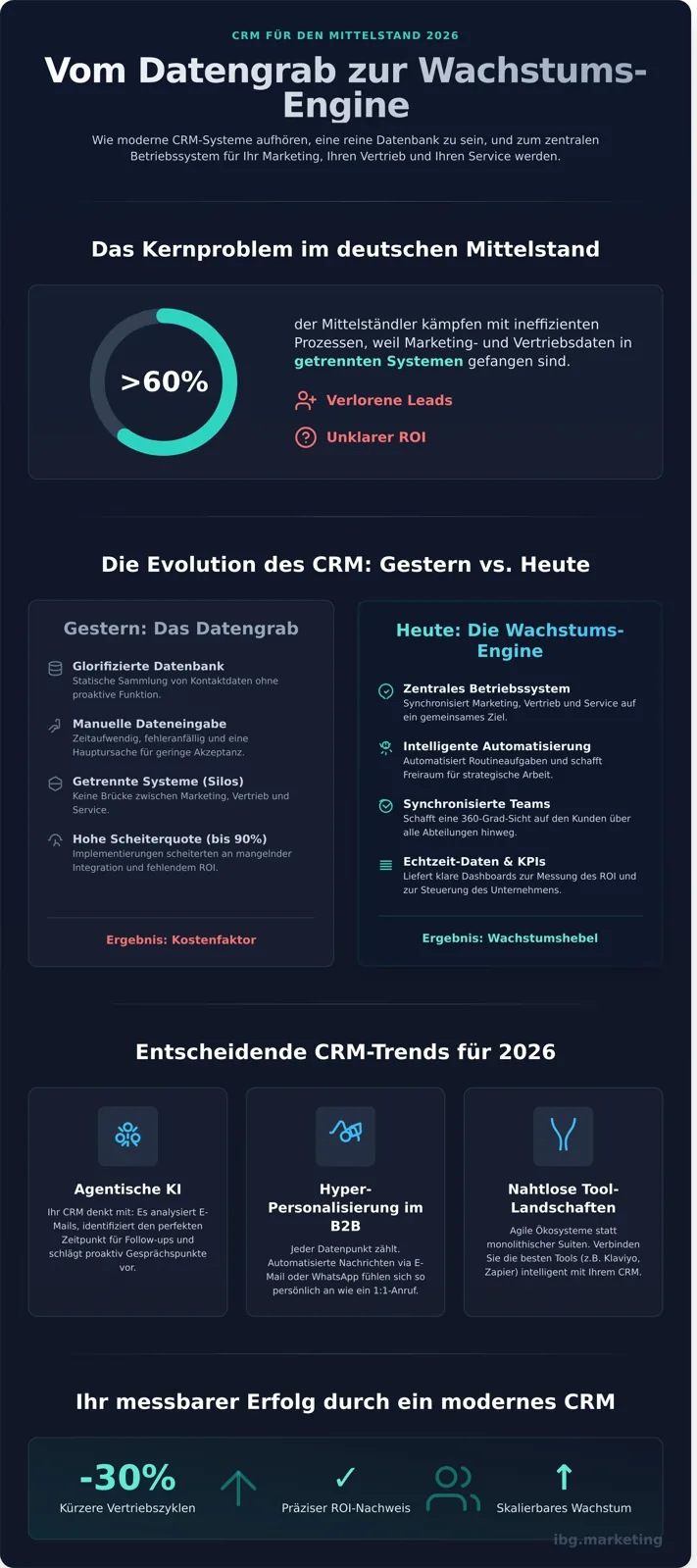
Studies from 2024 show that more than 60% of German mid-sized companies struggle with inefficient processes because marketing and sales data are trapped in separate systems. The result? Lost leads and an unclear ROI that can quickly reach a six-figure sum per year.
Does this sound familiar? You invest in performance ads, but the valuable leads fizzle out in messy lists. Manual data entry robs your team of hours every day, and the bridge between the marketing promise and the sales reality is missing.
This is exactly where this guide comes in. We show you how the right CRM system for mid-sized businesses in 2026 stops being just a data graveyard and instead becomes your central operating system for growth. Learn how to automate the entire customer journey seamlessly, from the first ad to the final close, and prove the return on investment of your marketing spend with precision.
In the following sections, we analyze the decisive features, compare the leading platforms, and hand you a clear roadmap for implementation, so you can scale your growth strategically.
Key Takeaways
• Discover why, in 2026, a modern CRM is no longer just a contact database, but the central operating system for your scaled growth in marketing, sales, and service.
• Get to know the three decisive pillars of a modern CRM stack: AI-powered analytics, conversational commerce via WhatsApp, and scalable process automation.
• Get a detailed comparison of HubSpot and Pipedrive and find out which CRM system for mid-sized businesses in 2026 truly fits your goals, and where expensive scaling traps are lurking.
• Understand the critical steps of a successful CRM implementation, from analyzing your current process bottlenecks to defining measurable growth KPIs.
CRM System for Mid-Sized Businesses 2026: Why the Classic Database Is Obsolete
Forget Excel lists and dusty address books. In 2026, a CRM system is no longer just a digital filing cabinet for contact data. It is the central nervous system of your company, an intelligent, automated ecosystem that synchronizes marketing, sales, and customer service and aligns them toward a single goal: measurable growth. The question is no longer just what is a CRM system, but how it becomes the driving force behind your revenue.
This shift is fundamental. Away from pure administration, toward a proactive growth engine. That is exactly why the most agile startups, from Munich to Berlin, no longer rely on isolated point solutions, but on integrated platforms that map the entire customer lifecycle. In a world without third-party cookies, high-quality first-party data is the new currency, and your CRM is the central bank.
To better understand this concept, watch this video comparing the top systems for small and medium-sized businesses:
From Data Graveyard to Growth Accelerator
Statistics from the early 2010s showed that up to 90% of CRM implementations in mid-sized businesses failed. The reason? The systems were often just glorified databases, static data graveyards with no connection to real business processes. The data was outdated, team acceptance was low, and the ROI could not be proven. Today, that has changed. A modern CRM system for mid-sized businesses in 2026 gives leadership real-time dashboards that visualize critical KPIs like the conversion rate per channel or customer lifetime value.
At IBG Marketing, we configure CRM systems like HubSpot or Brevo not as software, but as a strategic tool. For our client Bridgewave, for example, we automated the sales pipeline so effectively that the sales cycle length was cut by 30%. Those are measurable results, not empty promises.
Trends 2026: What Decision-Makers Need to Know Now
Technological development is accelerating exponentially. To stay competitive, mid-sized companies need to know and adopt the decisive CRM trends for 2026. It's no longer just about automation, but about autonomy and intelligence.
Agentic AI
Imagine your CRM doesn't just book appointments, but analyzes a lead's email correspondence, identifies the optimal moment for a follow-up, and proactively suggests the next three talking points to the sales rep. This is not a distant vision, but the next level of efficiency.
Hyper-Personalization in B2B
The era of mass emails is over. Future systems use every data point, from the time spent on a specific web page to previous support requests, to create 1:1 communication. That's how an automated WhatsApp message becomes as personal as a phone call.
Seamless Tool Landscapes
Monolithic software suites are sluggish and expensive. Agile companies build flexible ecosystems from the best tools for each job and connect them intelligently via platforms like Zapier. A specialized email tool like Klaviyo, connected to an agile CRM, beats any all-in-one solution.
The right strategy transforms your CRM from a cost factor into your most important growth lever. It is the foundation for scalable performance ads and customer-centric communication.
The 3 Pillars of a Modern CRM Stack: AI, WhatsApp, and Automation
Forget monolithic, outdated CRM software. In 2026, success in the mid-market no longer rests on a single all-in-one solution, but on an agile, intelligently connected technology stack. A modern CRM system for mid-sized businesses in 2026 is no longer just an address book, but the engine for growth, efficiency, and a superior customer experience. The three decisive pillars that power this engine are artificial intelligence, direct customer communication via WhatsApp, and seamless automation.
This combination makes it possible to achieve results with a lean team that used to be conceivable only with large sales and marketing departments. It's about eliminating manual, repetitive tasks and focusing on what really counts: strategic decisions and valuable customer relationships.
The first lever is AI-powered lead qualification. Your sales team spends valuable time on leads that will never buy. AI systems analyze the behavior, interactions, and data of a new contact in real time and assign them a lead score. The result: your reps focus only on the 20% of leads with the highest close probability, boosting their efficiency by up to 40%. As Forbes emphasizes in an article on the role of AI in CRM, this intelligent prediction is no longer a future trend, but the basis for scalable acquisition.
The second pillar is conversational commerce. While email open rates often stagnate below 25%, WhatsApp messages achieve open rates of more than 95%. In 2026, WhatsApp is the most important channel for building trust and advising customers directly. This is where the decisive conversations happen that turn prospects into loyal customers. GDPR compliance is not an obstacle here, but a competitive advantage that builds trust in the DACH region and sets your brand apart in a positive way.
WhatsApp Marketing & CRM Integration
Seamless integration is the key. For our clients in Munich and beyond, we build automated funnels where a click on a Meta Ad leads the user directly into a qualifying WhatsApp chat. Every dialogue is automatically saved in the lead's CRM profile, so your sales team knows the full context. For newsletter campaigns, we rely exclusively on GDPR-compliant processes with a crystal-clear double opt-in to guarantee maximum legal certainty and high delivery rates.
Process Efficiency Through Intelligent Automation
Intelligent automation is the glue that holds the entire stack together. Using tools like Zapier, we connect your HubSpot CRM with dozens of other applications, without a single line of code. A new deal is won? An invoice is automatically created in accounting tool X and the project management board in Asana is updated. We set up automated dashboards that visualize your most important marketing KPIs in real time and put complex email nurturing sequences on autopilot. This is how you scale your processes without having to bloat your headcount. Let's find out together which automations can accelerate your growth in 2026.
HubSpot vs. Pipedrive: Which System Fits Your Startup?
For a growing mid-sized company, choosing the right CRM system is not a tooling question, but a strategic course-setting decision. It's about the central hub of your growth. Two names dominate the discussion again and again: HubSpot and Pipedrive. Both are excellent, yet they pursue fundamentally different philosophies. The wrong choice could cost you thousands of euros and valuable market share in 2026.
The decision between the all-in-one platform and the specialized sales tool depends directly on your business model. Before we compare the systems, it's important to understand the foundation. Today, a CRM is more than just address management. To understand why simple Excel lists are no longer enough, it helps to look at the definition: what is a CRM system? It is the nervous system that connects marketing, sales, and service and enables data-driven decisions.
HubSpot: The All-in-One Solution for Scaling Startups
HubSpot is not just a CRM. It is a complete ecosystem for growth. Its real strength lies in the seamless integration of Marketing Hub, Sales Hub, and Service Hub. For companies whose growth is based on content, inbound marketing, and complex marketing funnels, this unity is unbeatable. You can map the entire customer journey: from the first click on a Meta Ad, through nurturing via email automation, to the close by the sales team.
This is exactly why, as a HubSpot agency, we rely on this platform. With clients like Brera and Bridgewave, we see every day how connecting performance marketing data with sales activities makes the ROI measurable. Scalability is a decisive advantage. You start with free tools, but the real magic unfolds in the Professional and Enterprise versions. The scaling trap? The jump from "Starter" to "Professional" is financially significant and has to be firmly built into the budget, often from around €50 to more than €800 per month.
Pipedrive: Focus on Sales Efficiency
Pipedrive takes a different approach: maximum simplicity and efficiency for sales. The visual sales pipeline is intuitive and loved by sales teams, which massively increases team acceptance. If your business model rests on a strong, proactive sales team with clear processes, a lean Pipedrive CRM setup is often the fastest path to more closes.
Its strengths clearly lie in deal management and activity tracking. For sales-heavy teams that want to work fast and without fuss, it's ideal. But this is also where the limits lie: as soon as your marketing becomes more complex and you need lead scoring, deep automations, or a 360-degree view of the customer, Pipedrive reaches its limits. Integrating performance marketing channels like TikTok or Google Ads is possible, but often requires third-party tools like Zapier, which leads to potential data silos and additional complexity. For a future-proof CRM system for mid-sized businesses in 2026, this fragmented approach can become a barrier to growth.
In summary:
Choose HubSpot
if your growth is marketing-driven, you rely on inbound strategies, and you're looking for a single, scalable platform for all customer-related activities.
Choose Pipedrive
if your focus is 100% on the efficiency of your direct sales team and you need an extremely user-friendly tool for pipeline management.
But what if neither of these systems fits your unique business processes perfectly? For companies with very specific requirements, adapting to standard software can lead to compromises in efficiency. In such cases, a custom-built solution can be the better answer. If you're interested in the possibilities of custom software development, learn more about AP4 Digital.
Step by Step: The Successful CRM Implementation in 2026
Choosing the right tool is only half the battle. The real lever for your business success lies in the strategic implementation. A powerful CRM system only unfolds its full potential when it is seamlessly integrated into your processes and actually lived by your team. Without a clear roadmap, even the best software becomes an expensive data graveyard.
We break the process down for you into four battle-tested phases that make the difference between stagnation and scaling.
Phase 1: Analyzing Current Processes & Defining Goals
Before we talk about software, we talk about your pain points. Where exactly do leads get lost? Why does creating a quote take 48 hours instead of four? We quantify the bottlenecks. Instead of "slow processes," we say: "35% of MQLs are not contacted within 24 hours." On this basis, we define hard-nosed KPIs. A clear goal is the compass for your CRM system for mid-sized businesses in 2026. Example: "Reduce lead response time to under 2 hours and increase the close rate by 15% by the end of 2026."
Phase 2: Technical Setup & Data Migration
The implementation has to happen without downtime. Your day-to-day business keeps running. We plan the migration of your existing data meticulously, whether from Excel lists, old point solutions, or Outlook. Clean data is mandatory from day one. The principle "garbage in, garbage out" is the law here. A clean contact database is the foundation for every successful marketing automation and for precise sales forecasts.
Phase 3: Team Training & Establishing a Culture
The best system is useless if it isn't adopted. We don't just train your team in how to use it, we convey the strategic benefit and the responsibility of handling sensitive data. We establish a data-driven culture in which decisions are made based on facts instead of gut feeling. If, however, suspicion of data misuse or internal irregularities arises, it's important to act professionally. Here you can explore Corporate Investigations to bring clarity.
Go-live is the starting shot, not the finish line. After go-live, the real work begins: we analyze the performance data, optimize sales pipelines, A/B test email sequences, and adjust workflows. Only through this iterative process do you secure a lasting competitive advantage.
The IBG Methodology for Fast Implementation
We avoid over-engineering. Instead of activating all 200 features of tools like HubSpot or Pipedrive at once, we start lean with the core processes. Performance channels like Meta and Google Ads are connected from day one to make the ROI of every campaign measurable. For our client Bridgewave, a tech company from Munich, we cut the implementation time by 40% this way and reduced the sales cycle by 22% in just six months.
Overcoming Hurdles: Change Management Within the Team
Acceptance is decisive. We win over long-serving employees by involving them early and showing them how automations take annoying routine tasks off their plate. Motivating live dashboards that visualize sales wins in real time increase the usage rate by up to 30%. Quarterly audits also safeguard data quality and ensure that the CRM system for mid-sized businesses in 2026 remains a reliable basis for decisions. A flawless implementation is not a coincidence, but a strategy. Let's plan your CRM rollout together.
Conclusion: Your Path to Automated Growth With IBG Marketing
Choosing the right CRM system is more than a technical decision. It is a strategic course-setting for your growth. A CRM is not a cost center; it is the engine for scalable processes and measurable revenue. Anyone who wants to succeed in 2026 needs not just software, but an integrated growth strategy. The right CRM system for mid-sized businesses in 2026 is the foundation, but only flawless execution decides on success.
The real magic happens when your CRM works seamlessly with your performance marketing. Imagine this: a qualified lead from your Google Ad lands directly in HubSpot, is automatically segmented, and receives a personalized follow-up message via WhatsApp within 60 seconds. This closed loop of lead generation and nurturing increases close rates by up to 40% in our experience. This is exactly where our strength lies: we don't just deliver the leads, we build the system that turns them into paying customers.
Looking toward 2030, one thing is clear: AI will revolutionize CRM systems. Predictive lead scoring, hyper-personalized customer outreach, and fully autonomous sales assistants are no longer science fiction. You lay the foundation for this today. A flexible, data-driven CRM system for mid-sized businesses in 2026 is the prerequisite for benefiting from these technological leaps and not falling behind.
Why IBG - Innovate Business Growth Is the Right Partner for Your CRM Stack
We don't think in individual channels, but in holistic growth systems. Our expertise unites the three decisive pillars for sustainable scaling: data-driven performance marketing, automated CRM, and high-converting WhatsApp marketing. Our proven strategies have helped agile startups like Brera and Bridgewave maximize their ROI and solidify their market position. We don't deliver clicks, we deliver results.
Book a Free, No-Obligation Strategy Call Now
The first step toward automated sales is a clear analysis. Stop guessing and start acting on data. We offer you a concrete roadmap tailored perfectly to your goals.
Free Audit
We analyze your current tool landscape and uncover untapped potential.
Individual Roadmap
You get a clear, step-by-step guide for your CRM rollout.
Direct Contact With Experts
Talk to the strategists who drive your growth and learn more about our services.
Are you ready to automate your customer relationships and scale your growth? Then now is the right time. Book your free strategy call for your company in Munich or remotely.
Scaling Is Not a Coincidence, but a Strategy
The path to sustainable growth is paved: away from rigid Excel lists, toward a dynamic ecosystem. The future belongs to companies that understand AI, WhatsApp communication, and intelligent automation not as add-ons, but as the core of their sales strategy.
Choosing the right CRM system for mid-sized businesses in 2026 is more than a technical decision, it is your strategic lever for measurably more revenue and efficiency. It's about shaping customer relationships proactively instead of just managing contacts.
As certified partners of HubSpot, Pipedrive, and Zapier based in Munich, we have already built profitable automation structures for companies like Brera and Bridgewave. Our specialization in WhatsApp funnel automation turns leads into loyal customers, and does so in a 100% GDPR-compliant way.
Stop giving away valuable potential. In a no-obligation conversation, let's analyze how your company can benefit from a modern CRM stack. Your growth for the coming years starts today.
Book a free strategy call now.
Frequently Asked Questions (FAQ)
What does a CRM system for mid-sized businesses cost in 2026?
The cost of a CRM system for mid-sized businesses varies widely in 2026 and depends on the number of users and the scope of features. Entry-level systems like the HubSpot Starter plan begin at around €20 per user per month. Advanced solutions often sit between €50 and €100, while enterprise solutions quickly cost €150 and more. What matters is not the price, but the ROI. At IBG Marketing, we analyze your processes and find the system that scales your growth most efficiently.
How long does it take to implement a CRM like HubSpot?
A basic HubSpot implementation for a team of up to 5 people is often completed in 1-2 weeks. This covers setting up contacts, pipelines, and basic automations. For a more complex rollout with data migration from legacy systems, custom dashboards, and API connections, you should plan for 4 to 6 weeks. As a HubSpot Partner agency from Munich, we make sure your system works profitably from day one and is perfectly integrated into your tool landscape.
Is WhatsApp marketing within a CRM really GDPR-compliant?
Yes, WhatsApp marketing via a CRM is 100% GDPR-compliant if you use the official WhatsApp Business API. Three points are decisive: a clean double opt-in for the advertising consent, the use of an official API provider, and a clear, simple unsubscribe option. Private WhatsApp versions are off-limits for commercial marketing. For clients like Brera, we implement GDPR-secure WhatsApp funnels that demonstrably increase conversion rates.
Does my company need a CRM if we already use Excel?
Excel is a good start, but unsuitable for scalable growth. It lacks automation, a central source of data truth, and collaboration options, which leads to errors and missed opportunities. A CRM system automates routine tasks, gives the whole team a 360° view of the customer, and delivers data-based forecasts. Studies show that companies can increase their sales productivity by up to 34% by switching from Excel to a CRM.
Can a CRM system improve my Google and Meta Ads?
Definitely. A CRM is the key to maximizing your ad budget. By connecting your CRM with Google and Meta Ads, you see not only which campaigns generate leads, but which leads turn into paying customers with a high customer lifetime value. This closed-loop data makes it possible to steer ROAS precisely and to build highly profitable lookalike audiences from your best existing customers. This is the basis for our data-driven scaling strategy at IBG Marketing.
Which AI features are indispensable in CRM systems in 2026?
In 2026, three AI features are indispensable in a CRM system for mid-sized businesses. First, predictive lead scoring, where the AI automatically identifies the most purchase-ready contacts. Second, AI-powered content creation for quickly producing personalized emails and follow-ups. Third, intelligent chatbots that qualify customer inquiries around the clock. A modern CRM system for mid-sized businesses in 2026 has to have these efficiency boosters built in to stay competitive.
Turn this into results.
Branding, lead generation and done-for-you funnels, engineered with AI, live in weeks.
Book a free callChat on WhatsAppKeep reading

How to Set Up Automated Lead Rotation in HubSpot 2026: The Ultimate Guide
Set up automated lead rotation in HubSpot for 2026: cut response times, distribute leads fairly, and scale your sales team without
Read · 13 min →
Generating B2B Leads With Google Ads 2026: Strategies for Scaled Growth
Learn how to generate B2B leads with Google Ads in 2026: precise targeting, CRM automation with HubSpot and Zapier, and WhatsApp f
Read · 16 min →
CRM Implementation Checklist 2026: The Ultimate Guide for Agile Startups
Skip the costly CRM mistakes. This 2026 implementation checklist walks agile startups through strategy, data migration, and change
Read · 15 min →