
Benefits of a CRM System for SMBs in 2026: The Ultimate Growth Guide

Your Excel spreadsheet is the biggest enemy of your growth. Yes, you read that correctly.
It is clumsy, error-prone, and it isolates your most valuable data from the departments that need it most: sales and marketing. You know the feeling: manual data entry eats up precious time, leads get lost in the chaos, and the lack of transparency in your sales funnel costs you real money and plenty of frustration.
In this guide, we won't just cover the theoretical benefits of a CRM system for SMBs. We deliver a concrete roadmap for 2026. You'll learn how a single source of data automates your sales processes and makes your company truly scalable, without ever losing the overview.
We analyze how tools like HubSpot and Pipedrive act as a growth engine, and we show you battle-tested strategies that we at IBG - Innovate Business Growth already run successfully for agile startups like Brera as well as for countless SMBs in the region and beyond.
Key Takeaways
• Learn why Excel is blocking your growth and how a central database enables scaling, a core point when you look at the benefits of a CRM system for SMBs.
• One of the most important benefits of a CRM system for SMBs is the 360-degree customer view, which brings every interaction from email to WhatsApp together in one place.
• Discover how to maximize the benefits of a CRM system for SMBs by combining it with WhatsApp and Zapier to gain a decisive competitive edge in 2026.
• Get a clear strategy for rolling out your CRM so you can fully realize every benefit of a CRM system for SMBs, plus a decision guide on whether HubSpot or Pipedrive is the better fit for you.
Why SMBs Without a CRM Will Hit Their Growth Ceiling in 2026
The rules of the game have changed. While your team is still digging through Excel spreadsheets for customer data, digital-native startups are already winning the next deal. In 2026, the market will no longer tolerate manual processes and data silos. A modern CRM system (Customer Relationship Management) is no longer optional; it is the central nervous system for every growing company, your single source of truth for all customer interactions.
Without this central data source, you are flying blind. Leads slip away, sales opportunities fizzle out, and customer service reacts instead of acting proactively. That is the reality of "Excel hell," which actively prevents scaling. To better understand this concept and the solution, watch this short video:
The customer journey has changed radically. Today, customers expect instant, personalized answers across channels like WhatsApp or email. They have no patience for companies that first have to check internally what the last touchpoint was. Traditional SMBs that rely on isolated tools and manual lists systematically lose out to competitors who use tools like HubSpot or Pipedrive to capture every touchpoint seamlessly and make it usable for sales.
From Address Book to Growth Enabler
An Excel sheet is passive data management. A CRM is active sales enablement. The difference is fundamental. But what is a CRM system at its core? It is a strategy that puts the customer at the center and is supported by technology. We see it every day with our clients in Munich: companies like Brera that centralize their customer data boost sales efficiency by up to 30%. A CRM is not just a database; it is the indispensable foundation for any scalable marketing automation.
The Cost of Doing Nothing
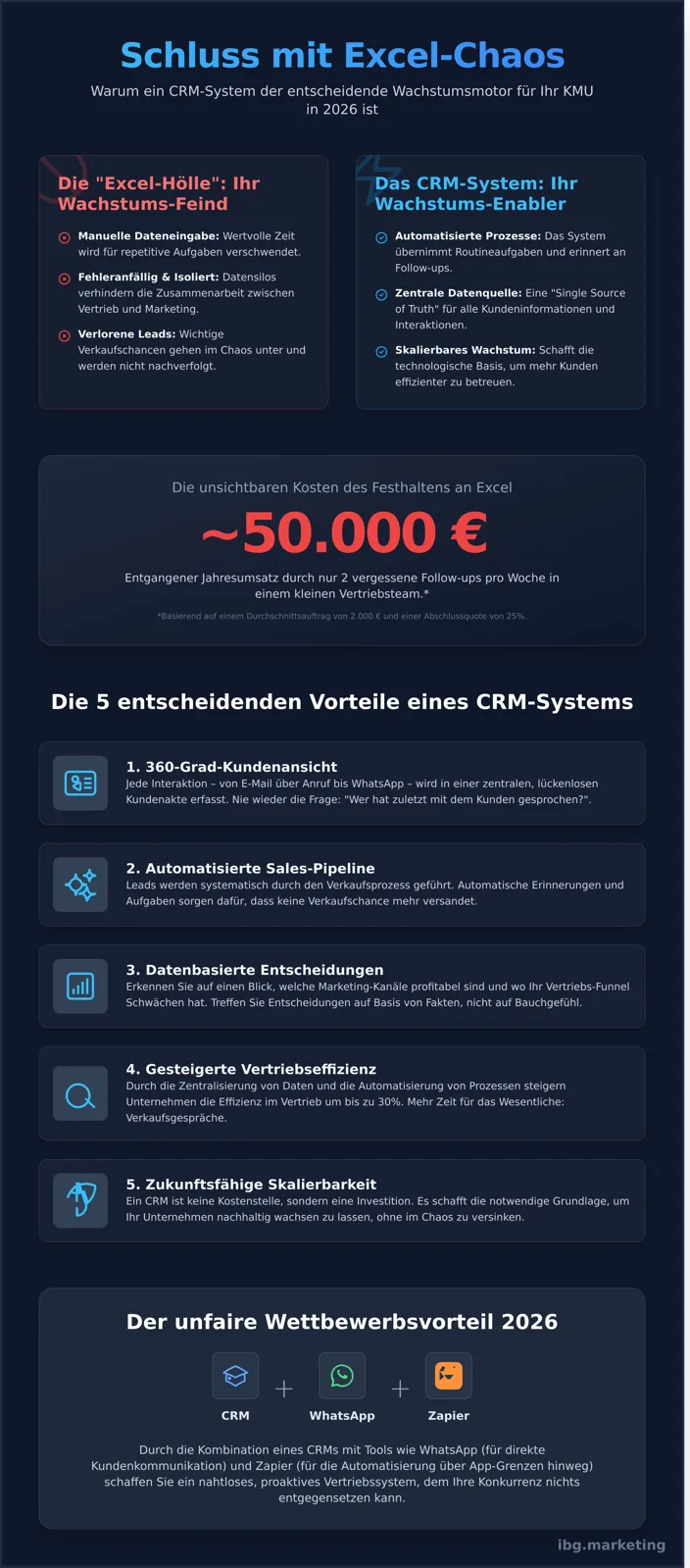
Clinging to old processes is more expensive than any software license. Let's do the math: suppose your three-person sales team forgets just two important follow-ups per week. With an average deal value of €2,000 and a close rate of 25%, that means more than €50,000 in lost revenue per year. The decisive benefits of a CRM system for SMBs lie precisely here: in the systematic avoidance of such losses and in maximizing every single sales opportunity.
On top of that come the opportunity costs:
Manual Data Entry
Time your team should be investing in sales conversations instead.
Missing Analytics
Without a central data foundation, you cannot tell which marketing channels are profitable.
Inefficient Handovers
Important information gets lost between marketing, sales, and service.
A CRM is not a cost center; it is a direct investment in the scalability and future value of your company.
The 5 Decisive Benefits of a CRM System for Mid-Sized Businesses
Forget messy Excel lists and outdated contact details scattered across different email inboxes. For a growing SMB, clinging to manual processes is not a strategy, it is a brake on growth. A central CRM system is not just an administrative tool; it is the engine for scalable sales and lasting customer relationships. It brings all the threads of your business together in one place.
The real benefits of a CRM system for SMBs unfold when data, processes, and communication mesh seamlessly. Instead of relying on gut feeling, your decisions are suddenly based on hard facts. The result is not just more efficiency, but measurable growth. Let's look at the five decisive levers in detail:
360-Degree Customer View
Every call, every email, and every WhatsApp message is documented seamlessly in a central customer record. The question "Who spoke to customer Meier last?" becomes a thing of the past.
Automated Sales Pipelines
Leads move through the sales funnel systematically and without manual effort. The system reminds you of follow-ups, assigns tasks, and makes sure no valuable contact is lost.
Data-Backed Decisions
Real-time dashboards show you at a glance which sales channels work, how long your sales cycle is, and where potential is left untapped. Strategy instead of speculation.
Higher Employee Productivity
By automating routine tasks, your most valuable employees gain time for what really counts: the customer.
Future-Proof Scalability
The processes you establish today still work when your customer base doubles or triples over the next 24 months.
Boosting Efficiency Through Process Automation
Especially for small, agile teams of 5 to 15 people, time is the scarcest resource. This is where a CRM unleashes its full power by connecting to your existing tech stack. With tools like Zapier, we connect your CRM seamlessly to programs like Slack, Google Drive, or your accounting software. A practical example: a deal is marked as "won" in the CRM and automatically triggers the creation of a draft contract and a notification in the finance channel. Workflows like these save up to 5 hours per employee per week, time that flows straight back into sales. A detailed look at the costs and benefits of CRM systems for SMBs shows that, thanks to efficiency gains like these, the investment often pays for itself within just 6 months.
This principle applies across industries. Think of a highly specialized craft business that builds, for example, a custom-made sauna in Switzerland. A CRM can automate the entire customer process here: from the first inquiry, to scheduling the consultation, to sending out designs and coordinating installation. That way, the experts can focus on their actual craft, creating exceptional wellness oases.
Better Customer Retention and Personalization
In the B2B mid-market, the ability to hyper-personalize will decide market success by 2026. A CRM is the foundation for this. It lets you segment your contacts precisely, by industry, purchase history, or engagement level. That way you no longer send mass emails, but highly relevant offers instead. This data is worth its weight in gold for targeted email and WhatsApp marketing campaigns that are tailored exactly to the recipient's needs. As with our client Bridgewave, a technology provider from the greater Munich area, we were able to increase the close rate by 22% through personalized follow-up sequences based on CRM history. That creates not just revenue, but genuine trust.
CRM, WhatsApp & Zapier: The Unfair Competitive Advantage in 2026
The rules of digital sales are changing radically. While your competition still hopes for email open rates of 20%, the decisive conversation is already happening somewhere else: directly on your customer's smartphone. Intelligently connecting CRM, WhatsApp, and automation tools like Zapier is no longer a technical luxury. It is the decisive lever for SMBs to operate more agilely, more personally, and more profitably in 2026.
The trend is called conversational commerce. Today, customers expect instant, uncomplicated communication. With over 2 billion users worldwide, WhatsApp has become the most important interface to your CRM. Inquiries that used to languish in email inboxes are now answered in real time via messenger. Yet many SMBs shy away from this channel out of fear of chaos and GDPR violations. That's a fallacy. With the official WhatsApp Business API connected directly to a CRM like HubSpot or Pipedrive, you create a 100% GDPR-compliant and highly efficient sales channel.
Picture the process: a potential customer sees your Meta Ad, clicks the "Click-to-WhatsApp" button, and lands directly in the chat. An AI-powered bot handles the pre-qualification, asks the three most important questions, and automatically creates the contact, including the answers, in the CRM. Your sales rep receives an instant notification and can pick up the conversation seamlessly, with all the relevant information already in front of them. This isn't a distant vision, it's the standard for growth-focused companies in Munich and across Germany.
WhatsApp Marketing as a Conversion Turbo
Direct communication via WhatsApp outperforms classic email funnels in almost every respect. Open rates are above 90%, and the interaction is personal and immediate. But without a central system, this advantage runs into the sand. A CRM makes sure no WhatsApp lead is forgotten. Every conversation is documented, every contact is assigned to a sales rep, and every follow-up is scheduled. At IBG, we specialize in designing and implementing profitable WhatsApp marketing systems like these.
Seamless Tool Landscapes Instead of Isolated Solutions
One of the biggest but often overlooked benefits of a CRM system for SMBs is its ability to act as a central data hub. Isolated solutions, where each tool works on its own, are poison for scaling. This is where Zapier comes in: as the bridge that connects your specialized marketing tools. When you scale your Meta Ads, you cannot afford to transfer leads manually. Zapier automates this process and prevents data loss. Industry analyses show that integrated systems can reduce the error rate caused by manual data transfer by up to 40%. The result: more efficiency, more precise data, and a team that can focus on closing deals rather than on copy-and-paste.
This applies not only to lead generation, but also to managing customer feedback after the purchase. Specialized software can, for example, automate the process of collecting positive online reviews and thereby strengthen social proof, a decisive factor in earning the trust of new customers. To see how systems like these work, you can learn more about VéleményGuru, a tool that covers this aspect of customer relationship management.
CRM Rollout Without the Chaos: A Strategy for Agile Teams
The best software is useless if nobody uses it. A CRM rollout often fails not because of the technology, but because of a missing strategy. For agile SMBs, a pragmatic, step-by-step approach is the key to unlocking its full potential and building acceptance within the team. Forget month-long, complex projects. Focus on quick wins.
A structured rollout ensures that you realize the real benefits of a CRM system for your SMB from day one, instead of getting lost in technical details. The process can be broken down into five clear phases:
1. Needs Analysis
Start with your biggest pain points. Which manual processes cost your sales team more than 5 hours a week? Where exactly in the funnel do you lose the most leads? Define 3-5 core problems the CRM has to solve. Everything else is irrelevant for now.
2. Tool Selection
Choosing the right system depends on your growth stage. Pipedrive is excellent for pure sales teams. HubSpot, on the other hand, is an all-in-one platform that grows with your company and prevents data silos between marketing, sales, and service from the outset.
3. Data Migration
"Garbage in, garbage out." Before you import even a single record, your legacy data has to be cleaned up. Remove duplicates, correct outdated contact information, and segment your contacts cleanly. This step determines your future data quality and the success of your campaigns.
4. Team Onboarding
Acceptance grows from visible relief in everyday work. Roll out the features that deliver quick wins first. For example: an automated email sequence that saves every sales rep 30 minutes a day. Show the benefit rather than just training features.
5. Continuous Optimization
A CRM is not a finished project. It is a living system. Schedule quarterly reviews to adjust processes, build new workflows based on team feedback, and deactivate unused features.
HubSpot as the Gold Standard for SMBs
For most growth-oriented startups, a professional HubSpot CRM implementation is the strategically smartest decision. Its modular structure lets you start with the powerful free CRM and only invest in paid hubs (Marketing, Sales, Service) once the need is actually there. That keeps costs flexible and scales them with your success, which protects your liquidity and maximizes profitability.
Avoiding Common Implementation Mistakes
As a CRM agency for companies in Munich and the surrounding area, we see the same stumbling blocks time and again. The biggest mistake is "over-engineering": trying to build a perfect system for every conceivable future scenario from day one. That paralyzes the project and frustrates the team. Start lean. Another critical point is the lack of ownership. Appoint a clear "CRM owner" who is responsible for data quality, training, and ongoing development. Without this role, the initiative is guaranteed to fizzle out.
Do you want to reap the full benefits of a CRM system for your SMB without falling into the typical traps? Let's set up your CRM strategy together.
Conclusion: Your Path to Data-Driven Growth With IBG
For SMBs, introducing a CRM system is no longer an option today. It is a strategic obligation to stay competitive and manage customer relationships professionally. But the real transformation only begins afterward: intelligently automating your marketing and sales processes is the finishing touch that turns raw data into predictable revenue and scalable growth.
Many companies, however, underestimate the complexity of implementation. They lose valuable months trying to set up systems on their own instead of focusing on their core business. Working with an experienced HubSpot Partner agency speeds up this process by up to 70% and ensures that you get an infrastructure aligned with your goals from the very start. You avoid costly mistakes and see a faster return on investment.
The decisive question is not whether, but how quickly you reap the full benefits of a CRM system for your SMB. Don't wait until the competition has overtaken you. The technological course you set today defines your market success in 2026. It's time to move from reactive, static operations to a proactive, scalable sales system.
Why IBG - Innovate Business Growth Is the Right Partner for Your CRM Project
At IBG - Innovate Business Growth, we don't see ourselves as a mere service provider, but as a growth partner for ambitious SMBs from Munich and across Germany. Our approach is radically ROI-driven. For clients like Brera and Bridgewave, we didn't just implement tools like HubSpot; we built complete, data-driven sales and marketing ecosystems. We combine technical excellence with strategic foresight to deliver measurable results.
Next Steps for Your Company
The first step is often the hardest, but we make it easy for you. Let's find out together how a tailored CRM strategy can transform your company.
Potential Analysis
In a free, no-obligation strategy call, we analyze your current processes and uncover concrete growth potential.
Inspiration
Take a look at the impressive results we've achieved for other companies. Explore our client logos and success stories.
Decision
Make a well-founded decision for your future. Based on data, not on guesswork.
Ready to systematize your growth and fully unlock the benefits of a CRM system for your SMB? Then let's talk.
Your Path to Data-Driven Growth: How to Take Off in 2026
The facts are clear: without a central CRM system, growth for SMBs from 2026 onward becomes pure luck. The real revolution, however, lies in intelligently connecting customer data with automation tools like WhatsApp and Zapier. This is no longer a luxury, but the strategic foundation for scalable customer relationships and maximally efficient processes.
You now know the decisive benefits of a CRM system for SMBs, but knowledge alone generates no revenue. Execution is what counts. As an official HubSpot Partner and experts in WhatsApp marketing, we have proven for leading companies like Brera and Bridgewave how data turns into lasting profit.
Don't wait until the competition has overtaken you. The first step is a clear strategy that fits your agile team perfectly. Book a free strategy call for your SMB growth in 2026 now. Let's optimize your processes together and take your company to the next level.
Frequently Asked Questions About CRM Systems for SMBs
Which CRM software is best suited for an SMB with 10 employees?
For a team of 10 employees, scalable cloud solutions like HubSpot or Pipedrive are ideal. The choice depends on your focus: HubSpot offers an outstanding all-in-one platform that starts with free tools and scales with your growth in marketing and sales. Pipedrive is an extremely user-friendly alternative that is heavily focused on the sales process. As your agency partner, we help you select and implement the perfect system for your goals.
How much does a HubSpot CRM implementation cost in 2026?
The cost of a professional HubSpot implementation for an SMB in 2026 typically ranges between €2,500 and €15,000. A basic package for a small team covers the technical setup, the customization of pipelines, and fundamental training. More extensive projects include complex data migrations from legacy systems, the development of more than 10 marketing automations, and in-depth team workshops, which explains the higher costs. On top of that come HubSpot's monthly license fees.
Is using WhatsApp within your CRM really GDPR-compliant?
Yes, integrating WhatsApp into your CRM is 100% GDPR-compliant, provided you use the official WhatsApp Business Platform API. Unlike the free Business app, the API enables the legally secure processing of customer data, documents the necessary opt-in, and ensures that communication runs via European servers. Tools like Brevo enable a seamless and secure integration so you can run conversational commerce in a data-protection-compliant way.
How long does it take for a CRM system to be fully operational in a company?
A CRM system is usually fully operational for an SMB within 4 to 12 weeks. A straightforward process for a 5-person team can be completed in a month. For more complex requirements such as data migration, ERP connection, and specific automations for 10-15 users, you should plan for around three months. The decisive benefits of a CRM system for SMBs only unfold with full acceptance within the team, which is why we rely on an agile onboarding process.
Can I connect my existing ERP system to a modern CRM like HubSpot?
Yes, connecting an ERP system to a modern CRM like HubSpot is not only possible, it is essential for a 360-degree view of your customers. The connection is made either via native interfaces, which many ERP providers offer, or via a middleware platform like Zapier. This synchronizes invoice data, customer records, and inventory levels, which massively boosts efficiency in sales and service.
What advantages does a cloud CRM offer over an on-premise solution for SMBs?
For SMBs, a cloud CRM offers decisive advantages: lower upfront investment, maximum flexibility, and minimal maintenance effort. You pay a monthly fee per user and don't have to invest in expensive server hardware or IT staff. On top of that, your data is accessible from anywhere and the provider takes care of updates and security. This scalability and cost efficiency are central benefits of a CRM system for SMBs that want to grow in an agile way.
Turn this into results.
Branding, lead generation and done-for-you funnels, engineered with AI, live in weeks.
Book a free callChat on WhatsAppKeep reading

How to Set Up Automated Lead Rotation in HubSpot 2026: The Ultimate Guide
Set up automated lead rotation in HubSpot for 2026: cut response times, distribute leads fairly, and scale your sales team without
Read · 13 min →
Generating B2B Leads With Google Ads 2026: Strategies for Scaled Growth
Learn how to generate B2B leads with Google Ads in 2026: precise targeting, CRM automation with HubSpot and Zapier, and WhatsApp f
Read · 16 min →
CRM Implementation Checklist 2026: The Ultimate Guide for Agile Startups
Skip the costly CRM mistakes. This 2026 implementation checklist walks agile startups through strategy, data migration, and change
Read · 15 min →